arnac |
| The various sites are : |
| - The alignments |
| - The Saint Michel burial mound |
| - The burial mound of Kercado |
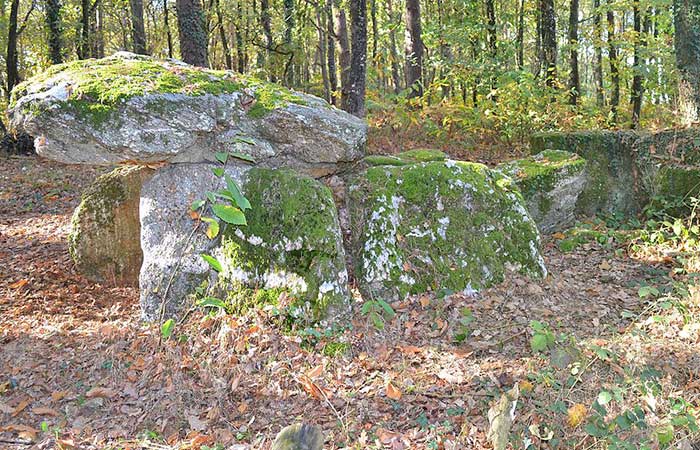
| - The dolmen of Mané-Kerioned |
| - The dolmen of Crucuno |
| - The dolmen of Manè-Groh |
| - The dolmen of Manè-Braz |
| - The dolmen of Rondossec |
![]() |
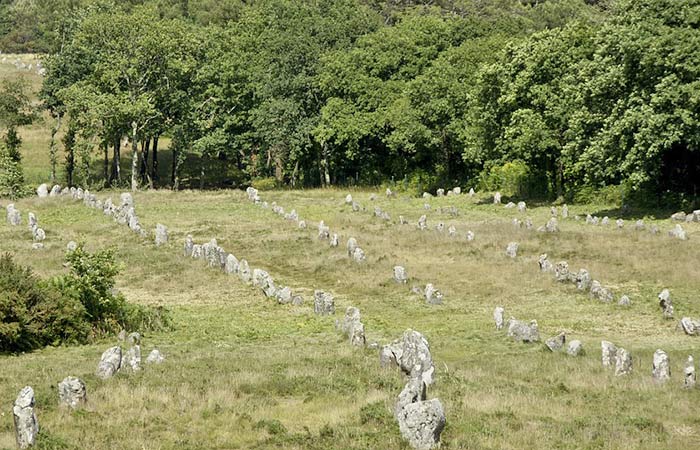
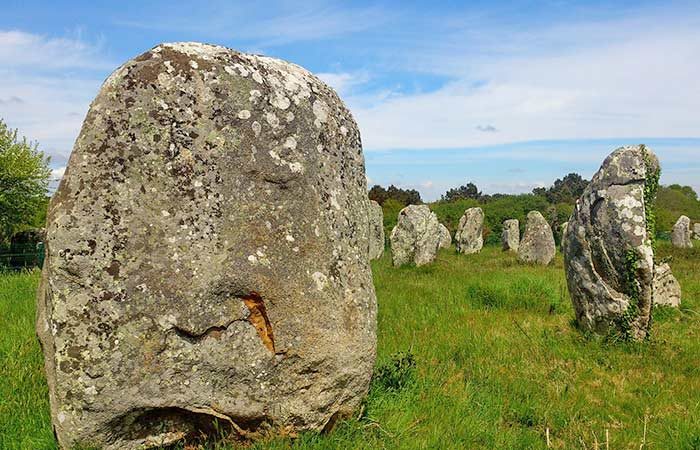
| There are many alignments, you will see Kerzerho, Sainte Barbe, Le vieux Moulin, Le menec, Kermario, Kerlescan and le petit Menec. |
| LE MENEC |
![]() |
| KERZHERO |
![]() |
| SAINTE BARBE |
![]() |
| Various theories were suggested concerning the use of these megaliths. |
| In 1796, La Tour d'Auvergne thinks Carnac was the place the druids chose to have their general meetings. |
| In 1805, A. Maudet de Penhoët adds precisions about the worship : |
| The stones would be placed as if they symbolised stars in the sky. |
| In 1887, H. de Cleuziou finds out that the orientation of the alignments of menhirs corresponds to the place where the sun rises during solstices. |
| The alignments extend on about 15 km from the West to the East. |
![]() |
| The Saint Michel burial mound is gigantic, it is 125 metres long, 60 metres wide and 12 metres high. |
| In 1862 René Galles excavated by boring several vertical wells. He dug down to a depth of 8 metres and reached the funeral crypt in which he found sumptuous pieces of furniture. |
| Le Rouzic carried out important excavations there from 1900 to 1907. A first dolmen was discovered, then a main vault was found in the middle, surrounded by about fifteen smaller graves. |
![]() |
| The dating showed that the monument was antique, and built at least during the 5th millennium BC. The dolmen on the west side is probably more recent. |
![]() |
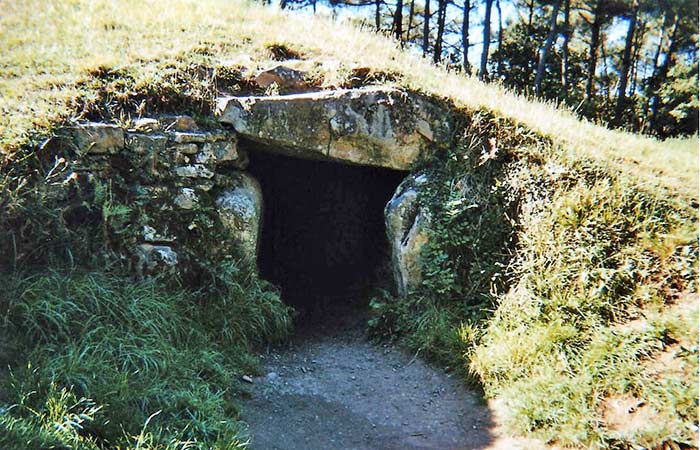
| This mound is 25 metres in diameter and 5 metres high and it is surmounted by a small menhir. |
| It was surrounded by a ring of small menhirs 4 metres away. |
| The corridor, which is wider at the entrance, is 6.5 metres long and leads to a rectangular room in which a huge axe decorates the ceiling. |
![]() |
| Numerous pieces of furniture, as well as axes, pearls, arrow heads and pieces of pottery, which were made between the Neolithic up to 2000 BC were found in Kercado. |
| It approximately dates back to 4600 BC, and people used it for almost 3000 years. |
![]() |
| Also known as Grotte de Grionnec (Grionnec cave) or Butte aux nains (Gnomes' mound), it is made of three dolmens that are the only ones in Brittany to be arranged like that : |
| The one on the west side is directed towards the North and South, the one in the middle is directed towards the East and West, and the one on the east side, which is more deeply buried, is also directed towards the North and South. |
![]() |
| It is thus different from the traditional organisation of parallel dolmens. |
| In the past the stones were concealed by a big burial mound that had been destroyed by an excavation. The mound was supposedly surrounded by a fence of menhirs, and part of the slabs still remain. |
| The dolmen on the west side is the tallest, it is 9 metres high. The central dolmen has a trapezoid chamber covered with a big table. |
| The third dolmen is still buried in the mound, and it comprises a unique set of engraved stones. |
![]() |
| This dolmen is classical : |
| It is a stone table laid on pillars. |
| The funeral monument measures 3.5 metres by 3.4, and is 1.8 metres high. It has an enormous slab that is 7.6 metres high and that probably weighs 40 tons. |
| In the last century there was also a corridor with big tiles which made the monument 24 metres long. |
| These tiles were cut up for the building of the village. |
![]() |
| This monument is said to have a partitioned chamber, for it comprises a 6-metres-long corridor leading to several separate compartments.. |
| The grave is encompassed in the vestiges of an oblong burial mound where a small wooden tomb was found. |
| Dating : between 4000 BC and 3500 BC. |
![]() |
![]() |
| This burial mound which is placed on a height of the moor is made of three dolmens with corridors. |
| Two of them were excavated in 1867. They contained stemmed vessels, arrow heads, pearls, axes. |
| Other pieces of pottery show that the monument was used until 2000 BC, and it is at that time that a small plaque of gold was added. |
![]() |
||
| Sub-circular cairn, about 20 metres high, comprising three dolmens with parallel corridors. | ||
| The biggest one in the East has a chamber on the left side to which a small rectangular compartment is connected. | ||
| These dolmens date back to 4000 BC. | ||
| To contact me | ||
|
||